A guest needs the right instructions for one stay. A host needs confidence that this link will not expose another property, another guest, or an internal note. Security is not a badge on a page; it is the set of boundaries around that ordinary interaction.
This article summarizes the published controls. For the detailed, maintained terms, read the Security Overview, Data Processing Addendum, AI Disclosure & Use Policy, and subprocessor list. Where this summary differs from a legal document, the legal document governs.
Access follows the account and stay
Database row-level security scopes host access to the host's own account and properties. Guests are not database users: guest reads and writes are explicitly scoped by property and stay. The service-role key is kept on the server, not sent to a browser. These controls are intended to keep a stay link from becoming a route to a different home or guest record.
The published Security Overview also describes encryption in transit and at rest through the database and hosting providers. Guest contact identifiers are stored as irreversible hashes rather than plaintext. A guest link should still be shared with the intended guest, not posted publicly.
AI has a narrower job
Moche-AI uses host-provided property material to answer in-stay questions. When the material does not support a confident answer, the assistant should decline to guess and route the issue to the host. Safety concerns and emergencies are for people and local emergency services, not for a chatbot to resolve. See how answers workfor the guest-facing boundary.
The AI policy describes redaction before external model routing and a check that blocks a routed request if personal data is still detected. It also describes fallback behavior and requests to providers not to log, retain, or train on prompts and responses. Consult the published AI policy and subprocessor list for the current processing details.
A host decides what goes live
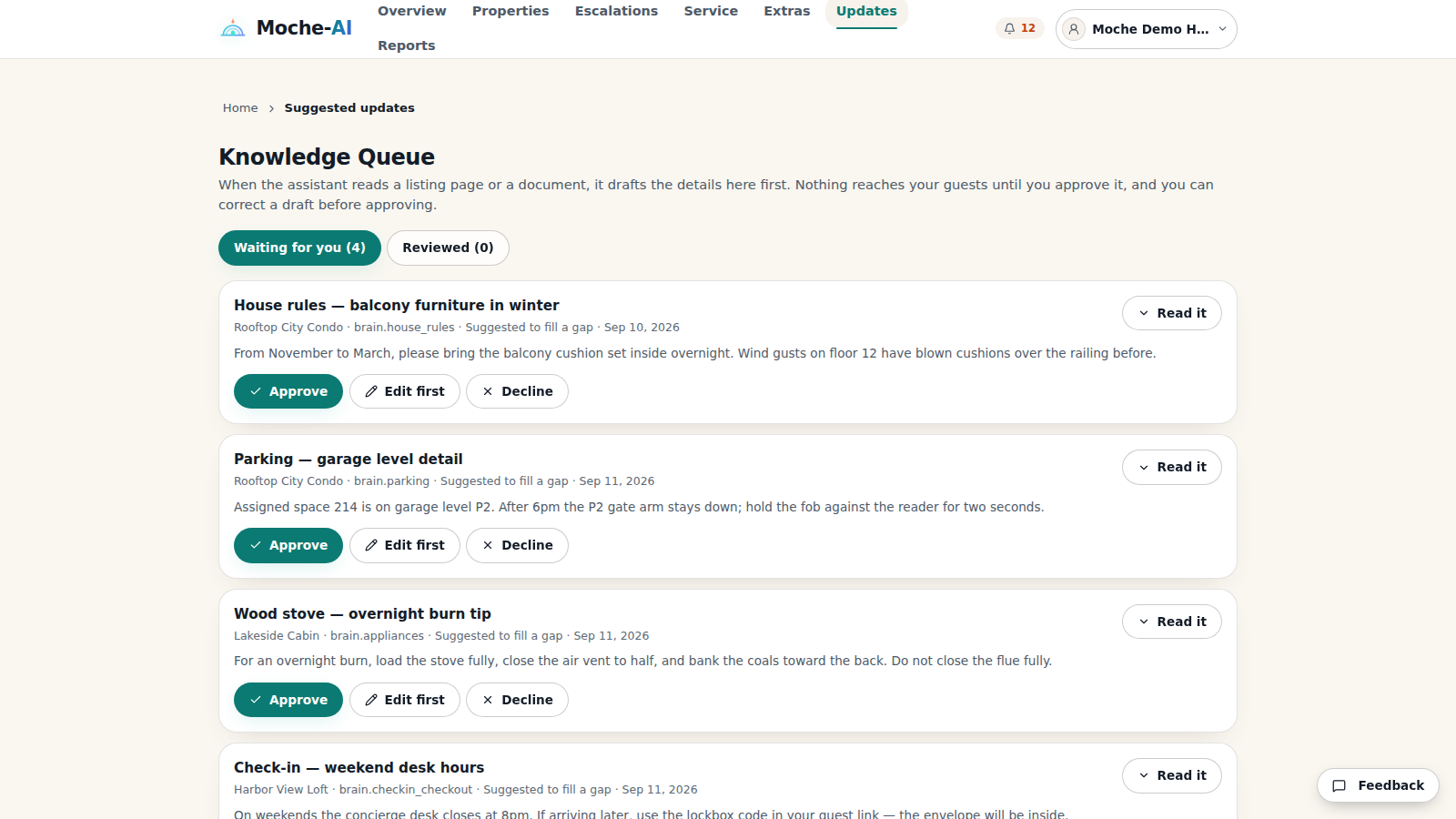
A suggested update to property knowledge is not the same as an approved guest answer. Drafted updates wait for a host to review them before publication. Hosts also decide requests involving availability, timing, or money. The assistant does not make a booking, take payment, or dispatch someone for a guest.
Payments, rights, and incidents
Stripe handles payment card data; Moche-AI does not store the card number. Hosts can consult the Privacy Policy and DPAfor data rights and retention, including records that may need to remain for legal or accounting reasons after an account closes.
The DPA commits Moche-AI, as a processor, to notify an affected customer-controller without undue delay and within 72 hours of becoming aware of a personal-data breach affecting that customer's data. That is a commitment to the controller, not a promise that every guest is notified directly within 72 hours.
What we do not claim
Moche-AI does not currently hold SOC 2, ISO 27001, or a comparable third-party certification. Controls modeled on those frameworks are not independent attestation. We do not claim that AI answers can never be wrong, or that the portal is an emergency response service. Read the Security Overview for the current assurance status rather than relying on a logo or a vague guarantee.
If you discover a vulnerability, report it privately through supportwith the affected area and steps to reproduce. Please do not test against another host's property or a live guest stay.
Last reviewed September 2026.